The TL;DR
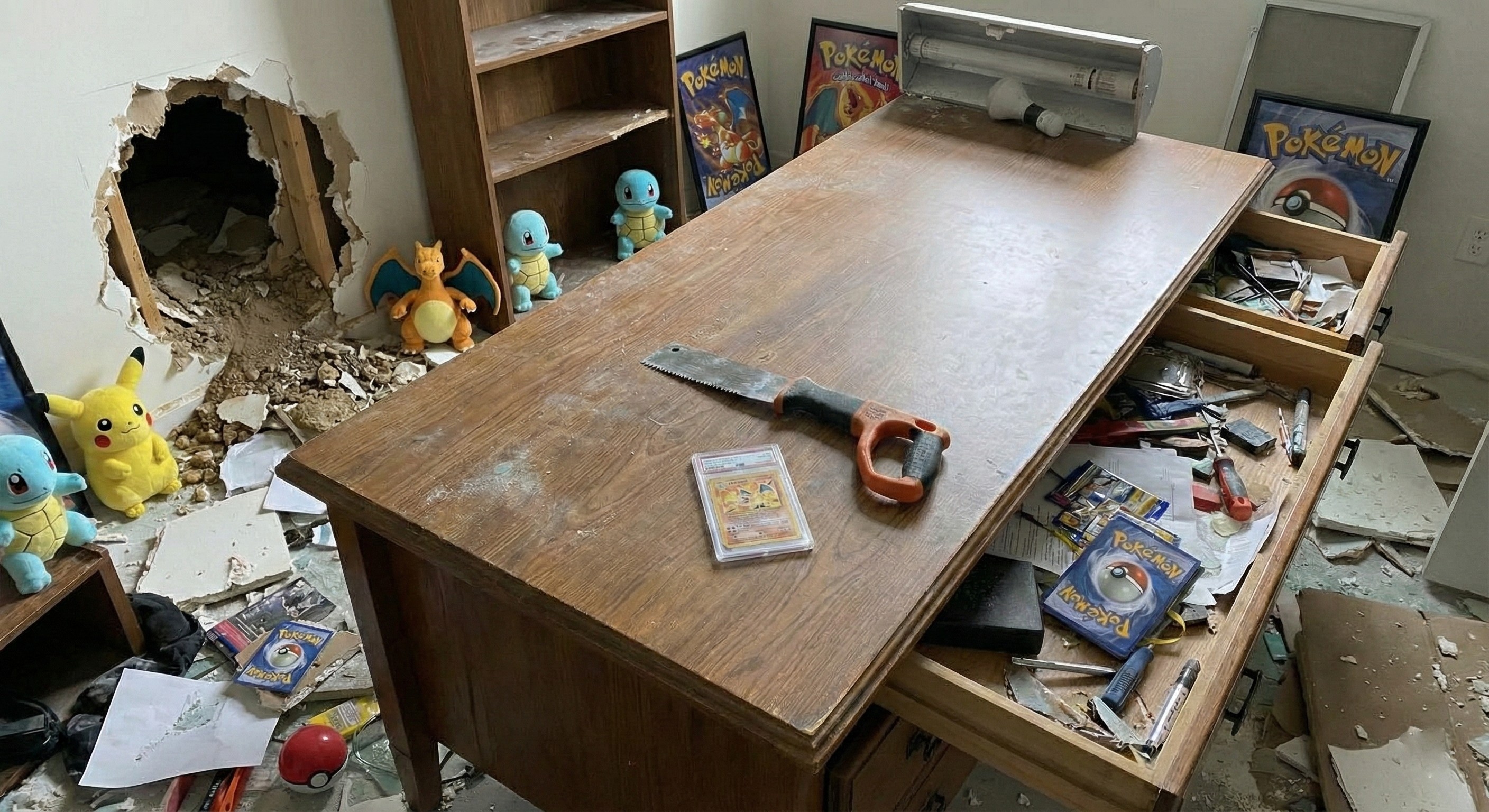
In the early hours of a Wednesday morning in Anaheim, a crew of professional burglars bypassed traditional security measures by tunneling through the drywall of a neighboring insurance office to gain access to DOWE Collectibles. The thieves made off with approximately $180,000 worth of rare cardboard—over 500 individual cards. Perhaps most telling was what they left behind: cash in the drawers and expensive electronics like computers and high-end cameras remained untouched.
For Duy Pham, the owner of DOWE Collectibles, received a security alert that signaled motion inside his shop. When he pulled up the live feed on his smartphone, he didn't see a front-door breach. Instead, he watched, heart pounding, as four masked figures emerged like moles from a jagged hole in the drywall. It was a scene of calculated destruction: the burglars had first forced entry into a neighboring insurance office, a low-security "soft target" that shared a wall with Pham’s vault of collectibles. Once inside the office, they used sledgehammers to pulverize the shared sheetrock, creating a crawlspace that bypassed every sensor on the shop’s reinforced front entrance.
Watching the footage was a surreal experience of absolute powerlessness for Pham. He called 911 immediately and began the frantic drive from Corona to Anaheim, but he knew the math was against him. Professional crews don’t linger; they operate on a stopwatch. By the time he arrived, the storefront was a graveyard of shattered glass and empty pedestals. The suspects had already vanished into the night in a dark-colored sedan, leaving behind a jagged aperture in the wall and a business in ruins. For those of us who have spent decades in this hobby, the feeling is all too familiar—the realization that the "children’s card game" we love has become so lucrative that it now attracts the same kind of criminal element that used to target coin shops and jewelry wholesalers.
The physical damage was extensive, but the psychological toll on the local community is deeper. DOWE Collectibles isn't just a shop; it’s a hub for the Orange County TCG scene. To see it treated with such industrial-level violence—sledgehammers through the walls, display cases pulverized—sends a clear message to every shop owner in the region: standard retail security is no longer a deterrent. We are operating in an era where the "Sheetrock Shield" is the only thing standing between a criminal and a six-figure payday, and as this heist proved, that shield is paper-thin.
The Thieves Knew Exactly What to Grab
In a typical robbery, thieves are chaotic; they grab whatever is portable and valuable—laptops, tablets, or the contents of the register. This crew was different. They moved through the store with a singular, terrifying focus, spending only five to seven minutes inside. They ignored the high-end cameras used for the shop's live-streaming breaks. They ignored the computer systems. They ignored the petty cash. They were there for the "slabs"—the graded, encapsulated cards that serve as the gold standard for the modern TCG market.
As Duy Pham later told investigators and local news outlets like KTLA:
"They didn’t touch our computers or cameras... They were here for the cards. One card can be worth up to $10,000. People see the money is there."
This wasn't a crime of passion by a disgruntled collector or a random smash-and-grab by a local opportunist. This was an asset-recovery mission. The thieves understood the "Grab & Slab" economics of 2026. Why bother with a $1,000 laptop that has a traceable serial number and a plummeting resale value when you can shove a stack of Ascended Heroes Mega Gengar ex SARs into a garbage bag? These cards are high-value, lightweight, and effectively untraceable once they hit the secondary market. They are the perfect liquid currency for the criminal underworld. The suspects reportedly cleared out more than 500 cards, targeting the specific cases that held the highest "chase" cards—the kind of inventory that would take a legitimate collector years of "ripping and sipping" to accumulate.
This marks a definitive shift in the "Poke-Crime" landscape. We are no longer dealing with kids stealing packs from the back of a Target; we are dealing with organized crews that understand market volatility and liquidation. They know that a PSA 10 "slab" is as good as a gold bar in 2026. The sophistication of using a sledgehammer to bypass security sensors by entering through a neighboring unit suggests pre-heist casing. They knew where the insurance office ended and where the high-value display cases began. This is "Ocean's 11" logic applied to a hobby that used to be about playground trades and binders.
How the Market Created the Monster
To understand why a group of men would tunnel through a wall for cardboard, you have to look at the shadow cast by the recent "mega-sales" that have dominated the global news cycle. Just earlier this month, the world watched as Logan Paul’s PSA 10 Pikachu Illustrator card sold for a staggering $16,492,000 at Goldin Auctions. While mainstream outlets like CNN and the BBC treated the story as a "quirky" curiosity of the post-pandemic investment boom, the criminal element saw it as a green light. When the public is told that a single Pokémon card is worth more than a Mediterranean villa, every local card shop stops being a community center and starts being a high-value vault.
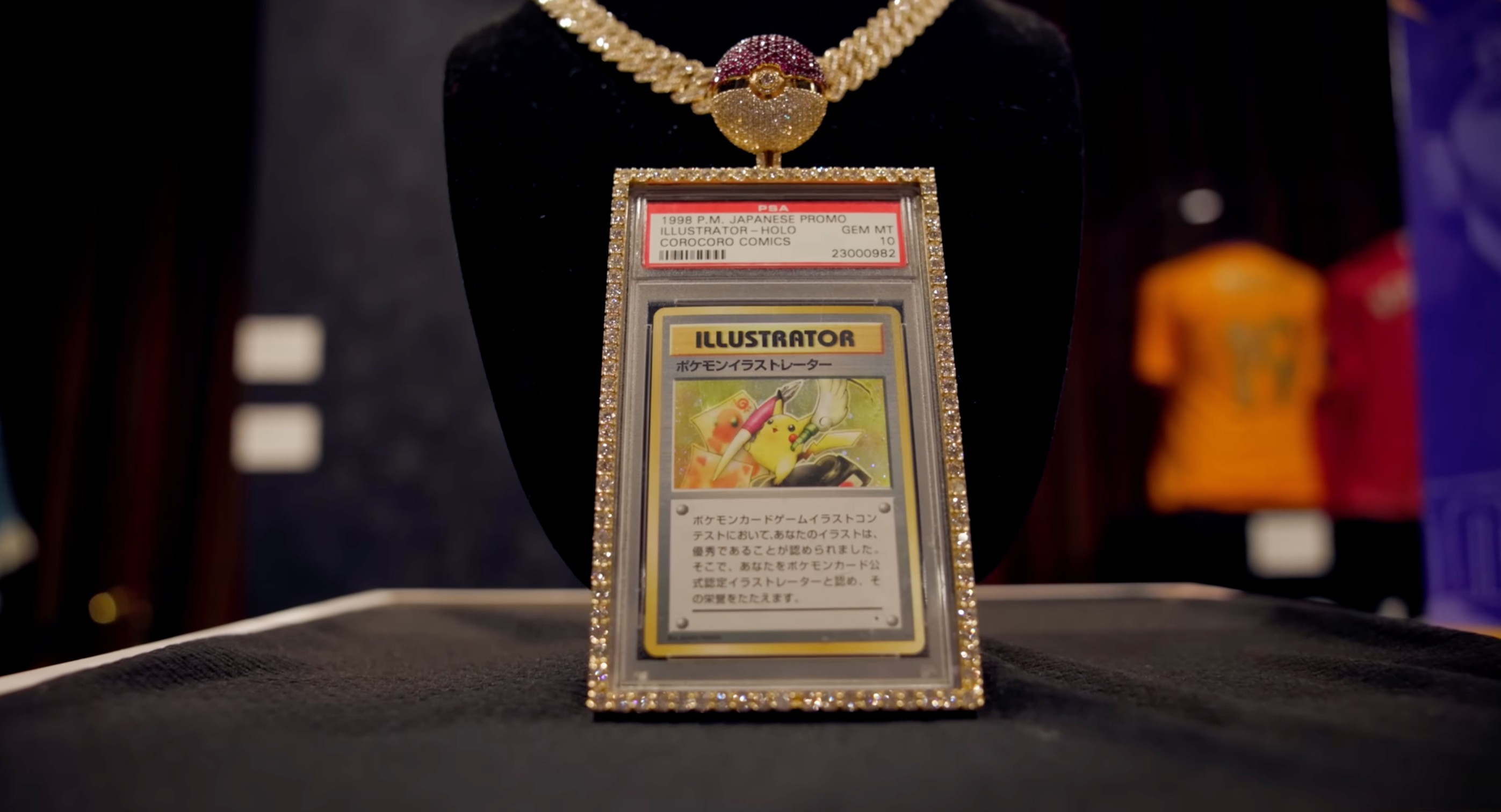
The "Logan Paul Effect" has inadvertently turned local businesses into high-stakes targets. The mainstream media's obsession with record-breaking sales has created a distorted reality where every "Charizard" is worth a fortune. This hyper-financialization has turned Pokémon cards into "alternative assets" that appreciate at rates often exceeding traditional stocks or even high-end real estate. According to data from CardChill, certain sealed products like Ascended Heroes booster boxes are seeing 40–60% yearly appreciation, while "Grab & Slab" investors are reporting 300-600% returns on cards like the Mega Dragonite ex SIR.
"It's naive to think people won't try anything to get your hundreds of thousands worth of products," noted one user on the r/PokeInvesting subreddit. "These shops are super soft targets with a shit ton of valuable items that're basically untraceable and super easy to move."
Criminals see these ROI percentages and realize they can skip the "buy" part of the equation. Why wait for a 500% return on a legal investment when you can achieve a 100% profit on stolen goods? The market has created a monster by validating the "value" of these cards to people who have no interest in the game itself, only the price tag. When the "buy" price for a raw card is $400 and the "slab" price for a PSA 10 is $2,000, the incentive for theft is higher than it’s ever been in the history of the franchise.
A Growing Wave of "Poke-Crime"
The Anaheim heist is not an isolated incident; it’s the latest peak in a rising tide of "Poke-Crime" that has been battering Southern California throughout early 2026. Just last month, the community was rocked by the "Poke Court" robbery in West Los Angeles, where thieves made off with a briefcase containing nearly $300,000 worth of high-value graded slabs. Only a week before that, a shop in Simi Valley was targeted by burglars who used a chainsaw to cut through the storefront before smashing display cases to grab $50,000 in cards. These aren't random occurrences; they are part of a coordinated trend where crews are moving from shop to shop, refining their methods.
This trend has gone global, reflecting the worldwide demand for the TCG. Across the Atlantic, the UK Pokémon community recently dealt with the "PokeDean" incident. PokeDean, a well-known collector and content creator, shared a devastating video detailing how his entire lifetime collection was stolen in a targeted home burglary. While some in the cynical corners of the internet—specifically on Reddit—have whispered about "insurance scams" and "fraudsters," the reality for most is much grittier. Whether it's a shop in Anaheim or a home in the UK, the "Team Rocket" moniker has moved from a nostalgic anime reference to a very real descriptor for organized theft.
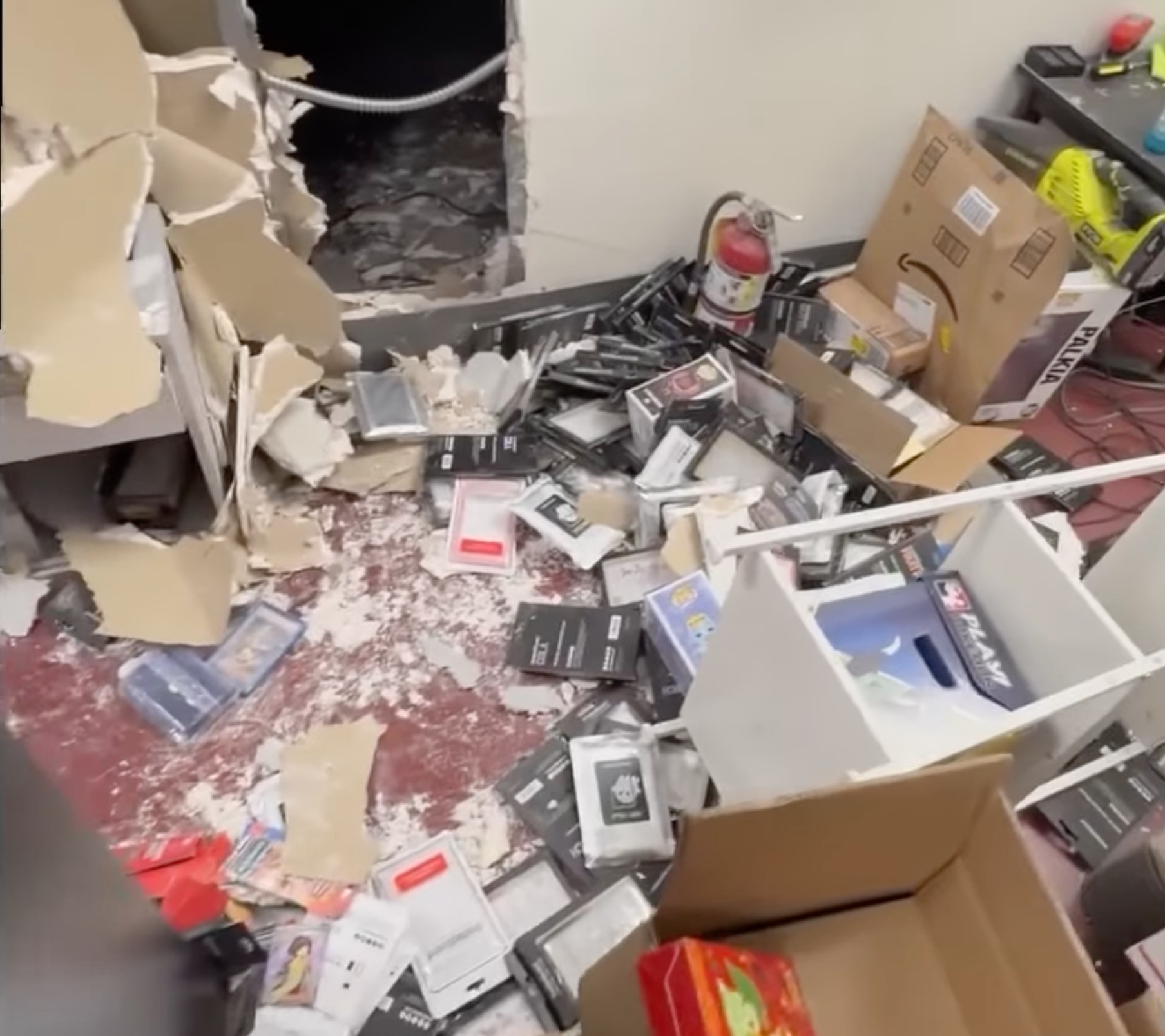
The enthusiast community is divided between horror and a grim sense of "I told you so." We are seeing a pattern where thieves are targeting the "soft spots" of the industry. As one Reddit commenter pointed out, the transition from sneakers to Pokémon cards as a primary target for "hype-theft" is nearly complete. Just as we saw people robbing trains for limited-edition sneakers five years ago, we are now seeing "chainsaw robberies" and "tunneling heists" for Pokémon. The common thread is the ease of liquidation. You can’t drive a stolen car across state lines without a high risk of capture, but you can carry $200,000 worth of Pokémon cards in a single backpack and sell them in small batches to unsuspecting buyers or "shady" vendors who don't ask for provenance.
Vulnerability in the Trading Card Game Business
One of the most discussed—and controversial—aspects of the Anaheim heist is the physical vulnerability of modern card shops. A recurring sentiment on the r/PokeInvesting subreddit was summed up by a user who pointed out that a "single sheet of Sheetrock protecting $180k is fucking wild." Let’s be real: most card shops operate out of standard retail plazas where the walls between units are nothing more than drywall and metal studs. If the unit next door is a low-security business like an insurance office, a dry cleaner, or a florist, the card shop's security is effectively zero.
There is a growing, opinionated consensus that the TCG industry is in a state of "security denial." Shop owners are spending thousands on high-definition cameras and alarms, but those are "after-the-fact" measures. They don't stop a sledgehammer. We are reaching a point where card shops need to "armor up" and start treating their inventory with the same level of physical security as a bank or a high-end jewelry store. This means reinforced steel mesh behind the drywall, floor-bolted safes for high-value inventory, and perhaps most importantly, the use of proxies.
"These owners need to be smart and utilize proxies for the cards they have in store," suggested one community member. "A single sheet of Sheetrock protecting $180k... you don't use an easily breakable material to store your valuables."
The argument for proxies—high-quality color copies for display while the real cards are kept in a high-grade safe—is becoming more persuasive every day. The joy of the "local card shop" has always been the ability to walk in and see the rare "grails" on display, but that very visibility is now a liability. The psychological impact on store owners is palpable; many report feeling like they have a "target on their back" from the moment they open their doors. When your inventory is more liquid than cash and more valuable than gold, the "Sheetrock Shield" simply isn't an acceptable standard of care anymore.
The timing of these heists is no coincidence. We are currently in the middle of a massive hype cycle leading up to the Pokémon 30th Anniversary in 2026. The release calendar for this year is absolutely relentless, and the demand is being driven to feverish levels by a roadmap of sets that feel more like investment vehicles than game expansions. We've just seen the launch of Ascended Heroes (January 30), which introduced the "brutal" chase for the Mega Gengar ex SAR and the Mega Dragonite ex SIR.
But the "Perfect Order" (set for March 27) and "Chaos Rising" (May 22) sets are already looming. Rumors are swirling about upcoming releases like Emerald Surge, Eternals, Shadow Storm, and the dual sets Radiant Ruby and Shining Sapphire. This constant barrage of new "Mega Evolution" cards has created a market where "Wave 1" product is gone in seconds, leading to "professional scalping" and a secondary market that is ripe for exploitation.
This fuels the "Grab & Slab" strategy—a high-energy approach where collectors buy raw cards, send them immediately to grading companies like PSA, BGS, or CGC, and wait for the "slabbed" value to multiply. This strategy is so dominant that it’s causing massive blockages at grading companies, further increasing the value of already-graded cards. When a card like the stamped Tyrunt IR promo or the N’s Zekrom promo from the Ascended Heroes ETB can be "slabbed" for a 5x multiplier, the incentive for criminals to jump the queue and just steal the inventory is massive. They aren't just stealing cards; they are stealing the "speed" of the market. They get the high-value assets without the "dryness" of mid-tier pull rates or the 45-day wait for a PSA return.